What I Mean When I Say Agentic AI Changes Everything
I posted on LinkedIn that 2026 is the year agentic AI changes who gets to call themselves a software engineer. A lot of people agreed. Some pushed back. Here's what I actually mean.
What Agentic AI Actually Is
Most developers are using AI to write code now. But they're doing it wrong.
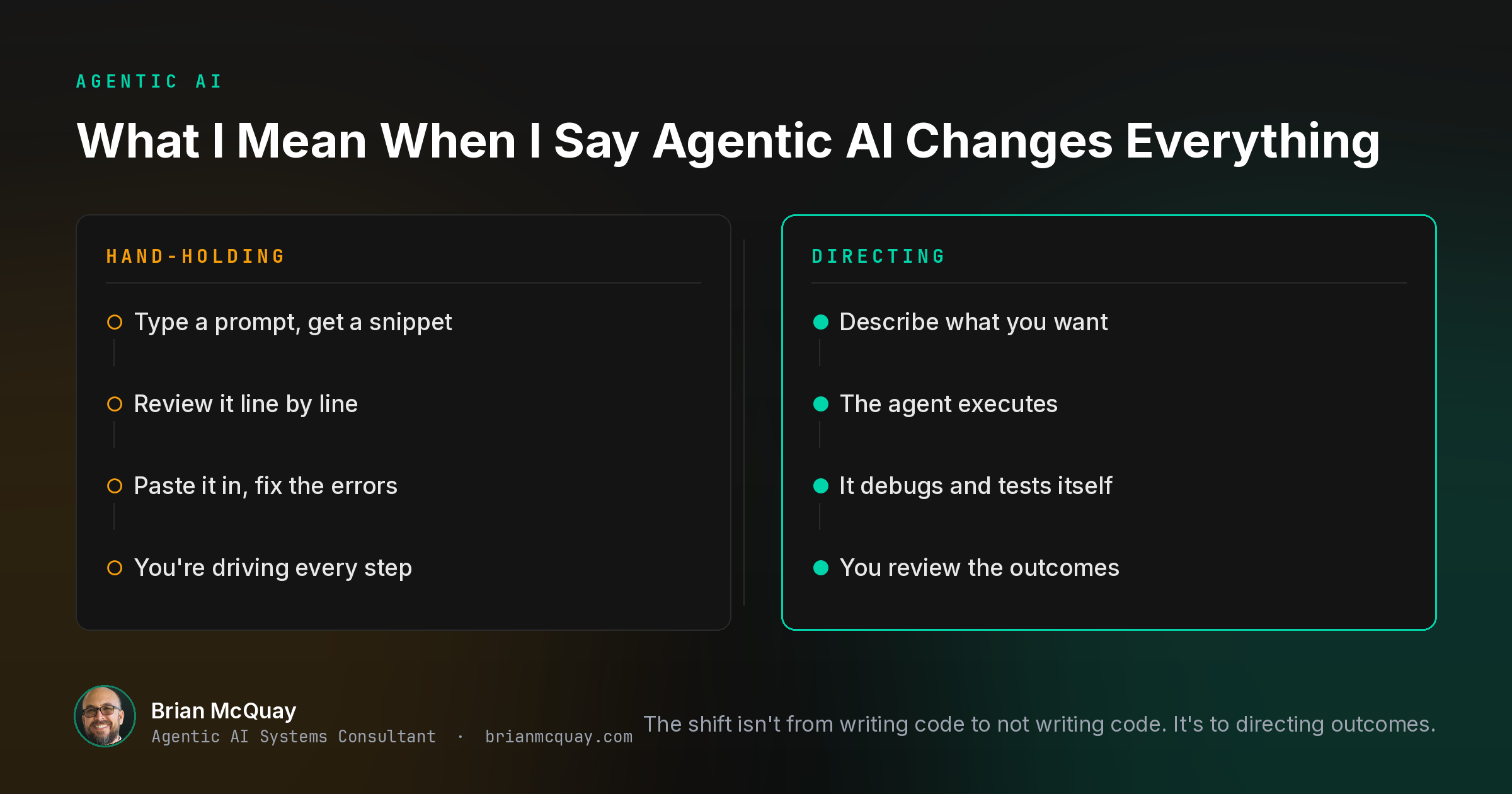
They type a prompt, get a code snippet, review it line by line, paste it in, run it, fix the errors, repeat. It's faster than writing from scratch, sure. But it's still hand-holding. You're babysitting the AI through every step.
Agentic AI is different. You describe what you want, and the agent executes. Not just generates code, but executes. It creates files, runs commands, debugs its own output, refactors when something doesn't work, writes tests, iterates until the job is done. You're not in the loop for every decision. You're setting direction and reviewing outcomes.
Here's a real example from last week. I needed to refactor part of a frontend, add a feature flag, and connect it to an API endpoint that itself needed to be abstracted into a service. Not trivial work. Multiple files, multiple concerns, coordination required.
I told Claude Code what I wanted and specifically instructed it to parallelize the work with subagents. It spun up, worked for about 15 minutes, and came back with everything done. Frontend refactored. Feature flag implemented. API abstracted into a service. Complete test suite included.
When I did the code review, I found myself nitpicking stylistic things, the kind of minor preferences that don't actually matter. I added those notes to Claude.md so it won't repeat those patterns, and moved on.
That task would have taken me two days with the old hand-holding style of AI development. Maybe a week without AI at all. Instead: 15 minutes.
This is not an incremental improvement. This is a category change.
Why Developers Are Afraid to Let Go
I get the resistance. I lived it.
For 30 years, I've built software. I've started companies, led teams, shipped products. My identity as an engineer was built on craftsmanship. Knowing the code, understanding every line, being the person who could trace a bug through the system.
When AI coding tools first emerged, I used them the way most developers do. Carefully. Skeptically. I'd generate a snippet, read every character, modify it, test it manually. The AI was a faster typewriter, but I was still driving.
Letting go felt irresponsible. If I'm not reviewing every line, how do I know it's right? If I'm not writing the code, what exactly is my value?
I felt uncomfortable with truly autonomous AI development until December 2025.
A friend invited me to pair program, and he walked me through the latest Claude Code updates. What I saw changed everything.
He pointed the agent at one of my old failed startups, a product I'd built and shelved because I couldn't find the market. The agent did market research. It analyzed the positioning. It identified what was wrong with the strategy. Then it modified the approach and rebuilt the entire frontend from scratch.
Thirty minutes. The whole thing.
The code was clean and well-tested. And since it built everything from scratch rather than copying my old code, it used a modern framework instead of the outdated stack I'd originally chosen. The market positioning was sharper than what I'd come up with. And honestly? It looked better too.
I went home that night and started experimenting with Claude Code from the command line instead of firing up an IDE like I'd done for three decades. I haven't looked back.
What Happens When You Actually Let Go
The shift isn't from "writing code" to "not writing code." It's from "writing code" to "directing outcomes."
You're still responsible for everything. You still need to understand what's being built and why. You still need to catch when something's wrong. But you're operating at a different altitude.
Instead of implementing a feature, you're describing what the feature should do and validating that it works. Instead of debugging line by line, you're reviewing the agent's debugging process and course-correcting when it goes down a wrong path. Instead of writing tests, you're specifying what should be tested and checking that coverage makes sense.
The speed difference is staggering. Work that used to fill a day now takes an hour. Work that took a week now takes an afternoon.
But speed isn't even the main thing. The main thing is that you can think bigger. When implementation cost drops by 90%, you can try ideas you never would have attempted. You can prototype three approaches instead of committing to one. You can build the thing and see if it works instead of spending weeks planning whether to build it.
The Skills That Actually Matter Now
If agents are writing the code, what do developers actually do?
This is the question that scares people, but the answer isn't "nothing." The answer is "the hard parts."
Understanding the customer. Agents can write code, but they can't sit in a meeting and read between the lines of what a frustrated user is really asking for. They can't see that the feature request is actually a symptom of a deeper problem. They can't decide what's worth building in the first place.
Navigating ambiguity. Real projects don't come with clear specifications. They come with vague goals, conflicting requirements, and stakeholders who don't know what they want until they see it. Translating that mess into clear direction is a human skill.
System thinking. Agents are good at local optimization. Making this function work, making this test pass. Humans are still better at seeing how pieces fit together, anticipating how a change here will affect something over there, maintaining coherence across a complex system.
Quality judgment. Knowing when code is good enough versus when it needs more work. Knowing when a shortcut is acceptable versus when it'll cause problems later. The agent will do what you ask; you need to know what to ask for.
Clarity of thought. People call it "prompt engineering," but that's a misleading term. What it really is: the ability to think clearly about what you want and articulate it precisely. This was always a valuable skill. Now, it is the skill.
What doesn't matter as much anymore: memorizing syntax, knowing every API by heart, being the person who remembers where every file is in the codebase. The agents have that covered.
What This Means for Your Career
If you're a junior developer: The learning path is changing. You still need to understand code deeply. You can't validate output you don't understand. But you won't write as much of it by hand. Your growth will come from learning to direct agents effectively, developing judgment about what good code looks like, and building the domain knowledge that lets you know what to build.
If you're a senior developer: Your judgment and system thinking become more valuable, not less. You're the one who knows when the agent's output is subtly wrong. You're the one who can see the architectural implications of a change. The agents amplify your expertise instead of replacing it.
If you're a leader: You need to rethink how you evaluate and grow your teams. Lines of code was always a bad metric; now it's completely meaningless. What matters is whether people can translate ambiguous requirements into working software that solves real problems.
The uncomfortable truth: some developers will thrive in this transition. Others will resist and fall behind. The difference isn't raw talent. It's adaptability. The ones who cling to "this is how I've always done it" will struggle. The ones who lean in and learn will build things that weren't possible before.
My Bet for 2026
I've seen a lot of "this changes everything" moments in 30 years of building software. Most of them didn't. This one is different.
Here's what I'm personally doing this year:
I've switched from IDE-first to CLI-first development. After three decades of living in an IDE, I now spend most of my coding time directing agents from the command line.
I'm continuously refining my agent configurations. Building up context files, adding notes when something doesn't work the way I want, treating the agent setup as a key part of my development environment.
I'm thinking bigger about what's possible. Projects I shelved because they'd take too long are back on the table. Ideas I dismissed as "too much work" are suddenly feasible.
And I'm watching closely to see what resonates and what doesn't, because this is all still new and nobody has it fully figured out yet.
The Real Point
When I say agentic AI changes everything, I don't mean code is dead or developers are obsolete. I mean the job is transforming. The work is becoming more about direction and judgment, less about implementation details.
The developers who recognize this shift and adapt will build things we can't imagine yet. The ones who cling to how it used to work will wonder what happened.
The question isn't whether to engage with this. It's whether you'll be directing the agents or being replaced by those who do.
I know which side I'm on. What about you?