The Future of Bug Fixes: When Exception Remediation Costs Approach Zero
Today we tolerate classes of problems because remediation cost is high. But what happens when that cost approaches zero? Our entire operational standards shift, fundamentally changing how we think about software quality and maintenance. I've spent over 25 years building software in remote and distributed environments, and I've watched our industry collectively accept certain compromises as inevitable. But as I work on agent orchestration systems and observe how AI is transforming the software development lifecycle, I'm seeing the contours of a future where one of our biggest compromises—how we handle exceptions—is about to become obsolete.
How We Handle Exceptions Today
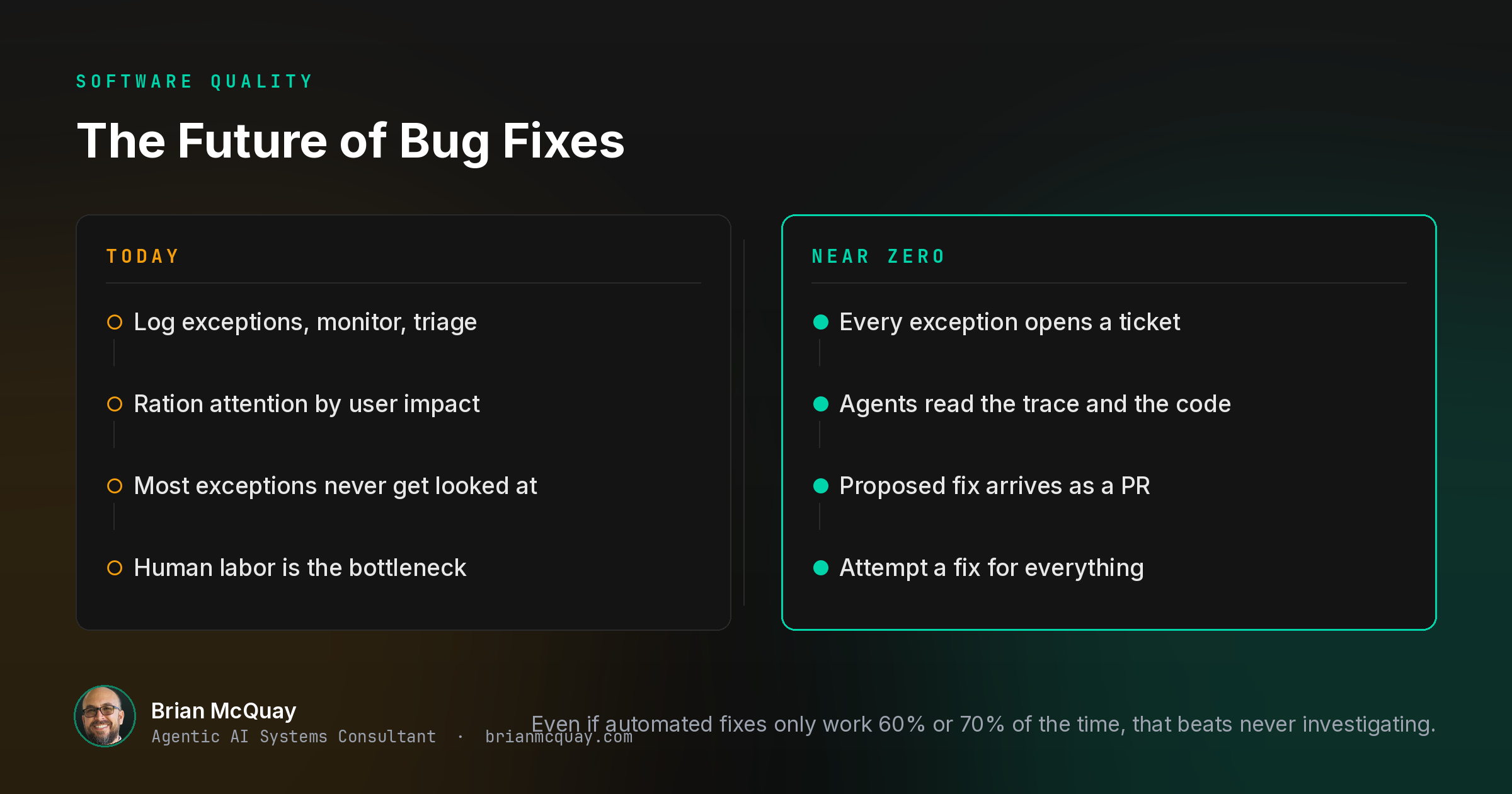
Right now, when I talk about bugs, I'm specifically referring to exceptions that get logged when our applications encounter problems. The current industry standard is straightforward: we log exceptions as they occur, we monitor them, and then we make decisions about which ones deserve our attention. This approach emerged not from laziness or lack of care, but from pure economic reality. As applications grow and user bases expand, we hit a hard resource constraint—there simply aren't enough engineering hours to investigate and resolve every exception that crosses our threshold. We've all been in those meetings where we look at exception dashboards and make judgment calls about what matters.
The triage process has become second nature to most engineering teams. Sometimes the threshold for action is relatively low, and we jump on issues quickly. Other times, the importance of an exception is immediately obvious—a critical payment processing failure or authentication breakdown demands instant attention. But for the vast majority of exceptions, we've developed elaborate criteria for deciding what gets fixed and what gets ignored. We look at how many users are affected, the volume of events coming in, the specific class of exception, the severity of the user impact, and countless other factors. None of these criteria are inherently wrong, but together they represent a collective admission: we cannot and will not address every exception that occurs in our systems.
This acceptance has shaped how we build software, how we staff teams, and how we think about quality. We've built entire monitoring systems around the assumption that human judgment and human labor will always be the bottleneck in the bug resolution process. We've normalized the idea that some percentage of exceptions will simply exist in perpetuity, backgrounded noise that never quite rises to the level of urgency required to warrant investigation. From a business perspective, this makes sense—why spend engineering time on an exception that affects 0.001% of users when you could be building new features or fixing more critical issues?
The Software Factory Model Changes Everything
But here's where things get interesting. As an industry, we're rapidly moving toward what I call the software factory model—a world where everything from ticket creation to deployment is streamlined and automated. I see this evolution firsthand in my work with agent orchestration systems. The traditional software development lifecycle, with its manual handoffs and human bottlenecks, is being compressed and automated at every stage. We're not just talking about continuous integration and continuous deployment anymore. We're talking about AI agents that can understand context, investigate problems, generate solutions, and potentially even deploy fixes with minimal human intervention.
In this emerging model, the economics of bug remediation fundamentally change. When an exception occurs, the cost of investigating and resolving it starts to collapse toward zero. Think about what becomes possible: every exception that gets logged could automatically generate a ticket. Each ticket could trigger an automated investigation process where AI agents analyze the stack trace, examine the relevant code paths, check recent changes, review similar historical exceptions, and identify the likely root cause. These same agents could generate proposed fixes, create pull requests with detailed explanations, and even write tests to verify the solution.
The implications are staggering. We're moving from a world where we have to carefully ration our bug-fixing attention to a world where we might be able to address every exception that occurs. The resource constraint that has defined our approach to software quality for decades could simply evaporate. When the cost of remediation approaches zero, our operational standards don't just improve incrementally—they transform completely. We stop asking "Is this exception important enough to fix?" and start asking "Is there any reason not to fix this exception?"
From Reactive Triage to Proactive Self-Improvement
This shift enables something I find genuinely exciting: proactive exception fixing. Instead of waiting for exceptions to reach some arbitrary threshold of importance, our systems could address problems as they emerge. An exception happens, gets logged, and triggers an automated workflow that investigates, proposes a fix, potentially even deploys it. The application essentially begins to heal itself, identifying and resolving issues before they compound or affect significant numbers of users. This isn't science fiction—the building blocks for this future already exist in the agent orchestration systems and AI tooling we're developing today.
Right now, most of us are focused on automating the middle parts of the development lifecycle. We're using AI to help write code, generate tests, review pull requests. These are valuable improvements, but they're still fundamentally human-initiated and human-supervised processes. Someone identifies a problem, someone requests a feature, and then we use AI to speed up the implementation. The next evolution is systems that can identify problems autonomously and move through the entire resolution lifecycle with minimal human involvement. We take the entire pipeline—from exception logging through deployment—and automate it end-to-end.
Will every automatically-generated fix work perfectly? Of course not. Will we need guardrails, testing, review processes, and human oversight? Absolutely. There will still be edge cases, complex bugs that require human insight, and situations where automated fixes introduce new problems. But the critical point is that we shift from a world where we can only afford to address a small fraction of exceptions to a world where we can afford to attempt fixes for everything. Even if automated remediation only works 60% or 70% of the time, that's still a massive improvement over our current state where vast categories of exceptions never get investigated at all.
What This Means for How We Build Software
This future changes how we should be thinking about software architecture and engineering practices today. If we know that proactive exception fixing is coming—and based on what I'm seeing in AI development, it's not a matter of if but when—we should be building systems that are ready for it. That means better exception logging with richer context. It means code that's more modular and easier for automated systems to reason about. It means building in the hooks and interfaces that will allow agent-based systems to safely investigate and modify our applications.
It also means rethinking our quality standards and what "good enough" looks like. When fixing bugs becomes nearly free, the calculus around technical debt shifts dramatically. We might stop tolerating entire classes of problems that we currently accept as inevitable. That rare edge case that affects one user per month? In today's world, it probably never gets fixed. In tomorrow's world, an automated system catches it the first time it happens and resolves it before the second occurrence. The accumulated weight of small issues that we've learned to live with could simply disappear.
I'm not suggesting this transition will be seamless or that it solves every problem in software development. Human creativity, judgment, and oversight will remain essential. Complex feature development, architectural decisions, and understanding user needs will still require human software engineers. But the routine work of identifying, investigating, and fixing exceptions—work that currently consumes enormous amounts of engineering time—is ripe for automation. And as someone who's been building software for over 25 years, I can tell you that freeing engineers from this reactive triage work would unlock tremendous creative capacity for more valuable work.
Building Toward the Proactive Future
The move toward proactive exception fixing represents a broader shift in how we think about software quality and maintenance. We're transitioning from a model where quality is limited by human resources to a model where quality is limited primarily by our imagination and our willingness to implement automated systems. This is the future I'm working toward in my own projects with agent orchestration, and it's the future I believe the industry needs to prepare for. The technology is emerging rapidly, and the companies and teams that position themselves to take advantage of near-zero remediation costs will have significant competitive advantages.
This transformation won't happen overnight, and it won't happen uniformly across the industry. Some teams and organizations will embrace automated exception remediation quickly, while others will move more cautiously. There will be failures, lessons learned, and best practices that emerge through experimentation. But the direction is clear: we're moving toward a world where the exceptions we currently tolerate become increasingly intolerable, where our operational standards rise dramatically, and where software can actively improve itself. For engineers and engineering leaders, the question isn't whether this future is coming—it's how quickly you'll adapt to it.