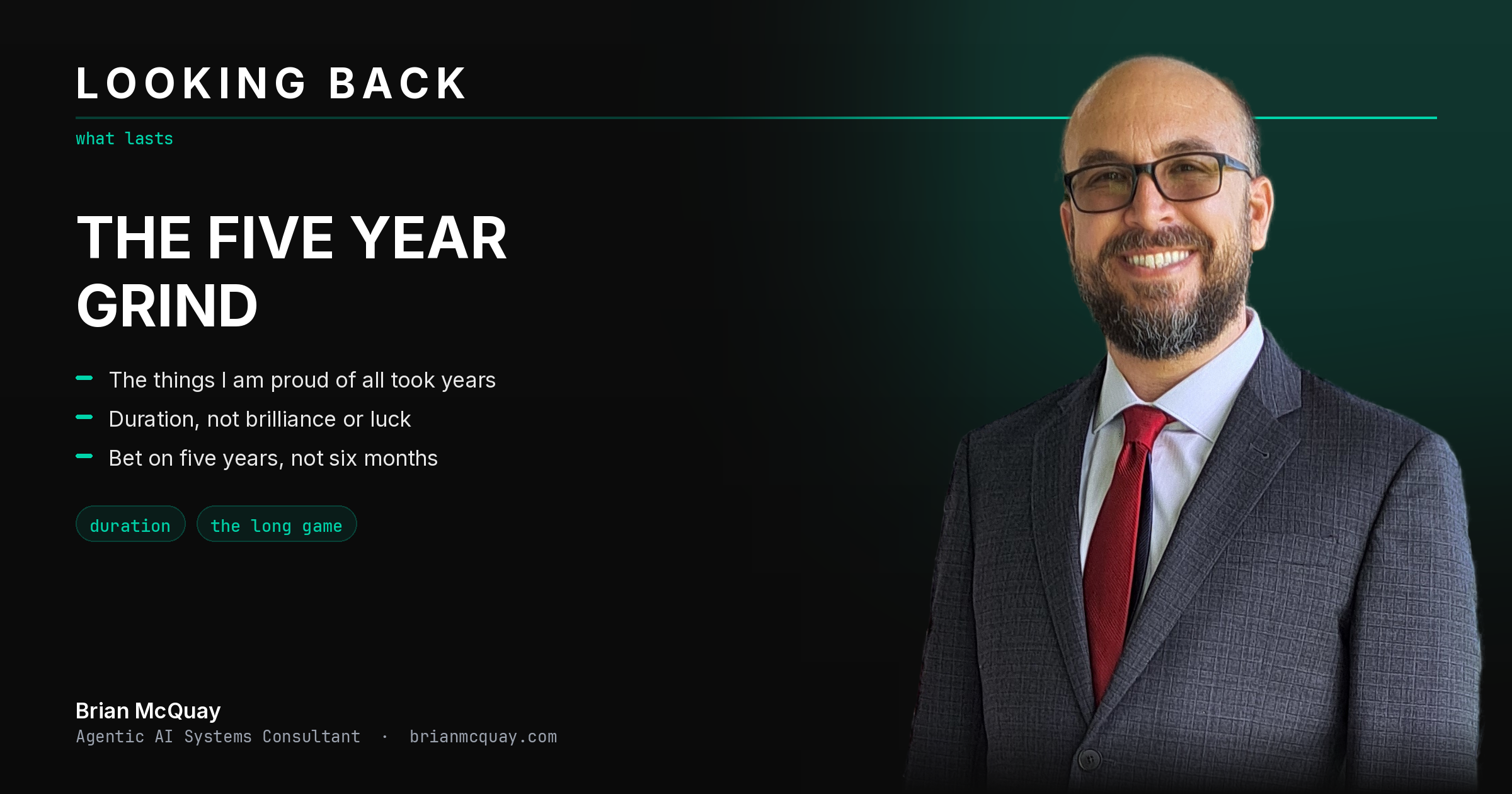
The Five Year Grind: Why Nothing Worth Building Happens in Months
Over the past 25 years of building software, I have started a lot of things. A consultancy I founded and ran for years. Custom applications for clients. Nine years as a software architect in EdTech. Side projects that piled up faster than I could finish them. And if I am honest about the pattern underneath all of it, one thing stands out: I have repeatedly gotten excited about something, ground on it hard for six months or a year, and then lost interest and moved on to the next shiny thing.
Looking back, I can see the pattern clearly because it repeated so many times. I would start something with genuine enthusiasm, put in real work, make real progress, and then somewhere around the point where the novelty wore off, my attention would drift. The projects that failed were not failures of skill or effort. They were failures of duration. And that distinction, I have come to believe, is the single most important thing I have learned about building anything worthwhile.
The Six Month Illusion
Here is the uncomfortable truth: nothing I have ever succeeded at was successful at the six month mark. Not one thing. When I ran my consultancy, was it a success six months in? No. A year in? Probably not. Two or three years in? It was starting to get there. It took years of consistent work before I could honestly look at it and call it a success.
This matters because most of us judge our projects on a timeline that is completely out of sync with how success actually works. Six months feels like a long time when you are living it. You have shipped features, solved hard problems, maybe even launched something to real users. And yet from the outside looking back, six months is barely the warm-up. The things I look at now and feel genuinely proud of, the things that made my career, all took years to mature. When I evaluate whether something is working, I now know that the six month evaluation tells me almost nothing. The two year evaluation starts to tell me something real.
The Repeatable Pattern of Quitting Too Early
What makes this hard to learn is that quitting at the wrong moment never feels like quitting. It feels like a rational decision. You tell yourself you have learned what you needed to learn, that the market was not ready, that you are a serial builder and moving on is just what builders do. Some of that is even true. But when the same pattern repeats over and over, you have to be honest with yourself about whether you are pivoting strategically or simply losing steam.
I have done this enough times to recognize the shape of it. The excitement phase carries you for a while. Then the grind phase arrives, where progress is slower and the problems are less fun. That is exactly the moment where interest fades and the next idea starts looking attractive. The problem is that the grind phase is where compounding actually happens. The reputation, the momentum, the deep expertise, the network effects of showing up consistently, all of that accumulates in the boring middle section that most people exit. If you leave right when it gets hard, you never collect the return on all the work you already put in.
My Advice: Timebox It to Five Years
If you asked me today what advice I would give someone who wants to be successful at building something, it would be this. Pick something you are genuinely passionate about and that you believe represents a significant opportunity worth chasing. Then commit yourself to five years. Literally timebox it. Write it down if you have to.
Why five years? Because based on everything I have built and watched myself abandon, five years is the honest duration for meaningful outcomes. Along the way, you may need to pivot. In fact, you probably should pivot at some point, maybe around the three year mark, because what you start with is rarely exactly what succeeds. Pivoting is not the same as quitting. Pivoting is adjusting your approach while staying committed to the outcome. The commitment is to the five years of grinding, not to never changing course. When you give yourself that long horizon, temporary setbacks stop feeling like verdicts. A bad quarter is just a bad quarter. A failed launch is just a failed launch. You keep going because you know the scoreboard only matters at the end.
The Grind Is Not a Mindset, It Is a Schedule
There is a version of this advice that stays comfortable: keep your goal in mind, visualize success, stay positive. I want to be more concrete than that. The grind is not a mindset. It is waking up on weekends and working nights, assuming you still have a day job. It is not watching TV. It is not kicking back. It is solving the endless stream of problems that stand between you and the thing you are building, every single day, for years.
Some days that means zooming out to see the whole landscape and reconsidering your approach. Some days it means zooming all the way in on a single stubborn bug or a stubborn decision. Both are the work. The skill is not heroic bursts of inspiration. The skill is showing up consistently and solving problems from different perspectives over an extended period of time. There is always another problem. That is not a bug in the process; that is the process. Solve the problem, then solve the next one, and keep doing it long after the initial excitement is gone.
What I Am Actually Proud Of
When I look back on my life, almost nothing I accomplished in days, weeks, or months makes the list of things I am proud of. The things that matter took years. Running my consultancy. Building a career across EdTech and property tech. Earning a college degree. Even the things with my family. The common thread is not brilliance or luck. It is duration. It is years of sustained effort on things that mattered.
That is the realization I want to leave you with. We massively underestimate what is possible in five years and massively overestimate what is possible in six months. The projects I abandoned at the one year mark might have become something real if I had simply kept going. The ones I did stick with are the foundation of everything I have now. So pick your thing. Make sure the passion and the opportunity are both real. Then commit to five years, pivot when you must, and grind. Not for months. Years.